


AI case notes are becoming a serious option for social care teams looking to reduce the time practitioners spend writing up visits, assessments and other interactions.
01
Record integrity
02
Data control and governance
03
Frontline working
04
Workflow and systems of record
The potential is clear. Social Work England’s 2026 research found that 83% of respondents felt AI could reduce the administrative burden on social workers. Respondents also saw potential for AI to improve the quality and consistency of case recording.
There is evidence of substantial time savings too. Kingston Council reported an average 50% to 60% reduction in the time social workers spent completing case notes and assessments during its initial AI note-taking pilot. Practitioners still edited transcripts and summaries to reflect their writing style and add detail.
Time saved is one part of the buying decision. Social care records can influence assessments, safeguarding activity, complaints, future decisions and legal proceedings. Buyers also need to understand the quality of the record, how practitioners check it, where sensitive information is processed and how the final record reaches the organisation’s case-management system.
These 12 questions give social care, digital, information governance, security and procurement teams a practical way to assess AI case-note platforms.
1. Can it produce the records your teams actually need?
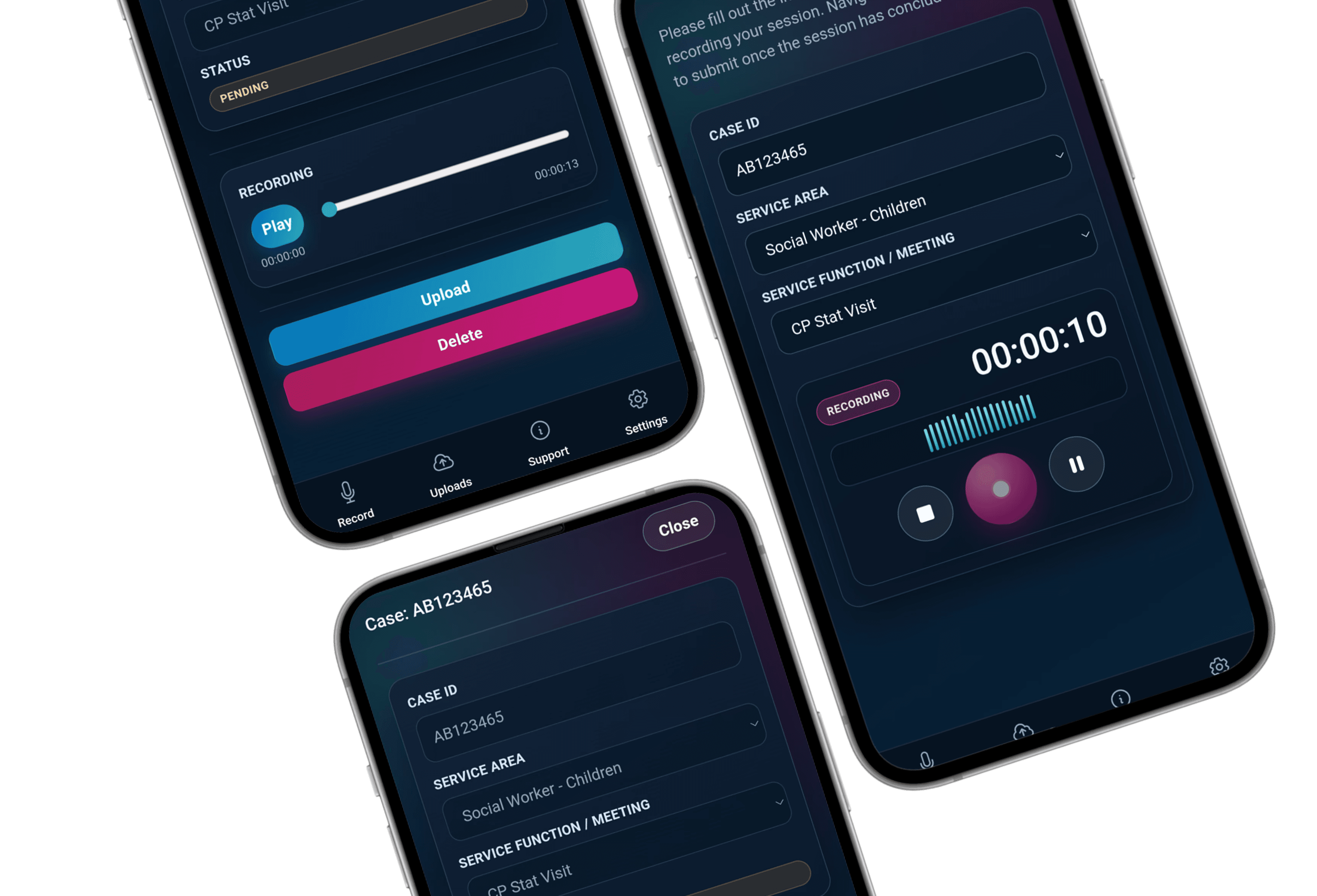
A transcript records a conversation. A case note needs to organise the relevant information in a form the organisation can use. Start with the records your practitioners already create: a Care Act assessment may need a different structure from a safeguarding conversation, supervision record, home visit or routine case note.
Ask suppliers to demonstrate the system using your forms and examples. Check whether it can follow different record structures, populate required sections and fields, identify missing or uncertain information, support templates used by different services and manage changes to those templates over time.
2. What does the practitioner have to review and approve?
The AI output should have a clear status. Practitioners need to know when they are reviewing an AI-generated draft and when a record has been approved for use. Ask to see the complete process from recording through to final record: who reviews the output, can they edit it, is approval recorded, can an unapproved draft reach another system, and what happens when the practitioner disagrees?
NHS England’s current guidance for AI-enabled ambient scribing says users should review and approve product outputs before further action. It also recommends ongoing audits of documentation and system performance. A demo should show this workflow clearly.
3. Can practitioners check generated statements against the source?
A concise case note can contain dozens of statements about finances, medication, safeguarding, family circumstances or mental capacity. Practitioners need a practical way to check important details. Ask whether the platform retains the transcript or audio for an agreed period and whether users can move easily between the generated record and the source material.
Some products link a generated statement to the relevant part of a transcript or recording. The Ada Lovelace Institute’s 2026 research identified the risk of hallucinated or misrepresented information entering statutory care records and found that responsibility for checking AI output currently falls heavily on social workers. Source traceability is worth testing during a pilot.
4. How is accuracy tested?
Ask for evidence of performance on conversations close to your own use case. A single transcription accuracy percentage tells you very little about the quality of the finished case record. Testing should cover different accents, multiple speakers, interruptions, names, local terminology, long discussions and poor recording environments.
Generated records need testing too. Does the summary omit important information, put information into the correct sections, distinguish something a person said happened from a hypothetical discussion, or invent detail? NHS England recommends defining measures for accuracy and reliability and monitoring performance after deployment.
5. How much correction does a usable record require?
Measure the practitioner’s work after the AI has finished. Two platforms could both produce a case note in 30 seconds and create very different amounts of work for the person reviewing it.
During a pilot, record time spent reviewing the draft, number of corrections, sections commonly rewritten, information frequently omitted, practitioner confidence in the final record, and manager assessment of completeness and consistency. The purpose is to understand the complete workload from interaction to approved record.
6. Where are recordings, transcripts and AI outputs stored and processed?
Ask the supplier to show you the data flow. One interaction can create audio, a transcript, AI prompts, generated drafts, a final record, application logs and backups. You need to know where each one goes.
Ask where audio is stored; where speech-to-text and AI processing happens; where the generated record is stored; which organisations and countries are involved; what is retained in logs; and whether customer information is used to train AI models. Generic statements such as “hosted in the cloud” or “built on Azure” are not enough for an information governance assessment.
7. Who controls the application environment?
A supplier can operate the application as a SaaS platform, embed it in a larger case-management product, or deploy it into cloud infrastructure owned by the customer. Each model creates a different split of responsibility.
Ask who controls application infrastructure, identity and user access, network configuration, storage, monitoring, security policy, retention settings and application updates. Security teams need the architecture, responsibility model and supporting evidence to decide which approach fits their requirements.
8. Will it work where social care actually happens?
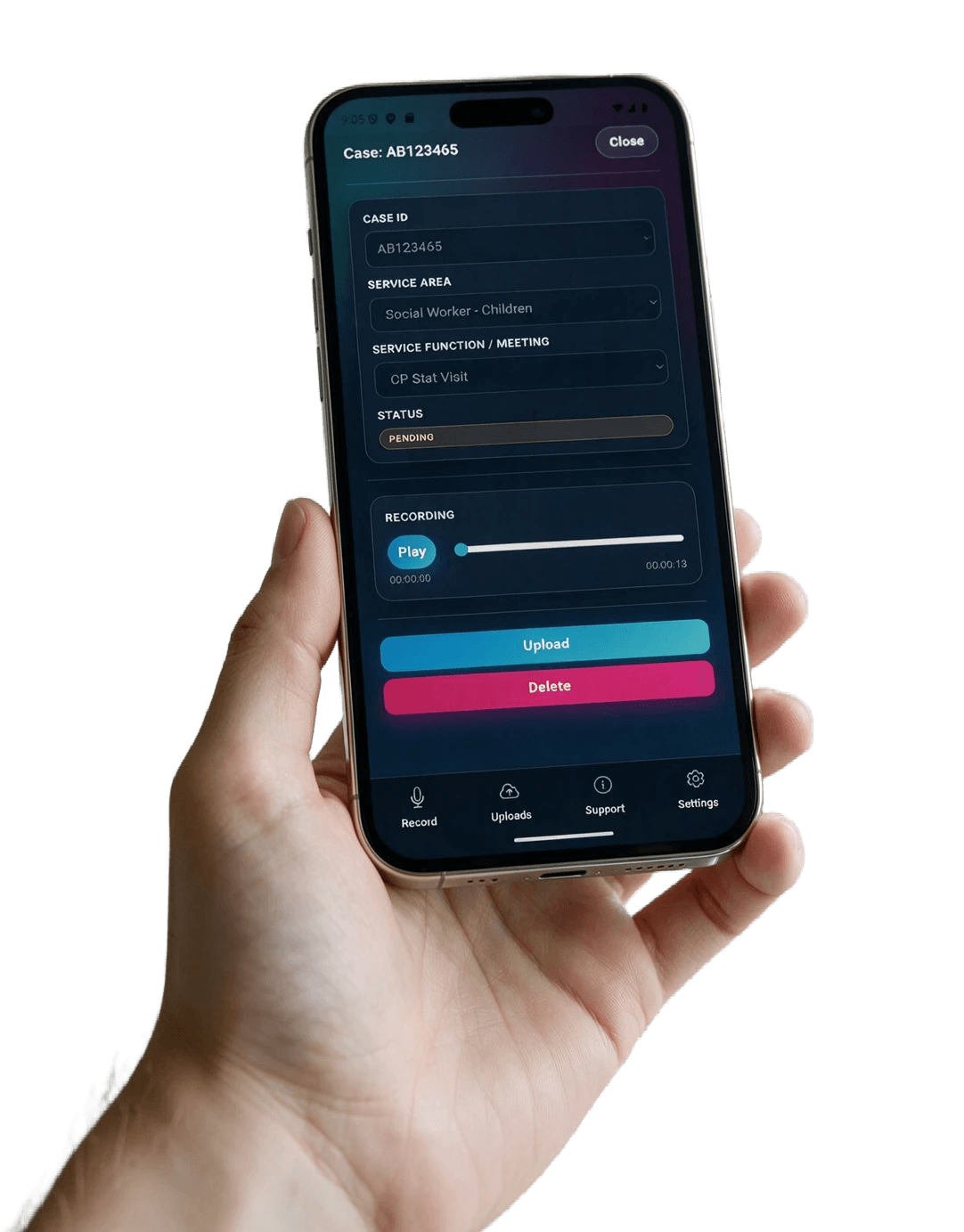
Many interactions take place away from a desk, where mobile connectivity can be weak or unavailable. Test the product in those conditions. Ask whether staff can record using supported corporate devices and whether recording continues without an internet connection.
If offline recording is supported, ask whether the file is encrypted while it remains on the device, when it uploads, what happens when an upload fails, whether users can retry safely and when the local copy is removed. Check how the application fits your approach to managed mobiles, user access, lost devices and application deployment.
9. How does the approved record reach the system of record?
Follow the process beyond the generated note. If a practitioner needs to copy information from one application and paste it into another, administrative work and recording risks remain.
Ask whether the platform can create or update the correct record, populate individual fields with structured data, match the person or case, authorise writeback, handle failed updates and support audit. NHS England gives system integration significant attention because it can reduce recording risk and improve data quality.
10. How are retention, audit and information governance handled?
Audio, drafts, transcripts, system logs, backups and final records may have different purposes and retention periods. Ask the supplier to document what is retained and for how long.
Establish whether the organisation can see who created the recording, when processing took place, which user reviewed the draft, what changes were made, who approved the final record and when information moved into another system. Bring information governance and data protection colleagues into the evaluation early. ICO guidance says some AI processing will require a Data Protection Impact Assessment, including certain high-risk processing involving personal data.
11. What evidence, onboarding and support come with the product?
Ask for evidence from organisations using the product in comparable settings: user numbers, length of deployment, workflow types, measured time savings, correction rates and evidence of record quality. Ask to speak to a customer where possible.
Then assess the work required to deploy it: who configures the service and templates, what training practitioners and managers receive, how assurance is supported, and who owns technical problems after launch. A production service needs clear ownership after the pilot team has moved on.
12. What will you measure during the pilot?
Agree the measures before the pilot begins. Track efficiency through average write-up time, time to approved record and backlog; record quality through correction rate, completeness, consistency and confidence; operational performance through failed recordings, offline success, processing failures and system transfer; adoption through active users and support requests; and governance through review completion, incidents and findings.
The result should give leadership enough evidence to decide whether to move into production, change the deployment or stop.
Use the same questions for every supplier
AI case-note platforms take different approaches to the same problem. Some are specialist SaaS products with substantial social-care adoption. Some connect directly to an existing care platform. Microsoft 365 can create AI-assisted notes for meetings and calls. Organisations with their own cloud and engineering capability can build custom workflows too.
A useful comparison keeps the questions consistent. Assess each option across record integrity and professional accountability; data control, security and governance; frontline working; workflow and systems of record; adoption, service and evidence; and commercial and strategic fit. Ask suppliers to provide evidence for their answers rather than comparing feature lists.
Where Servent Notes fits
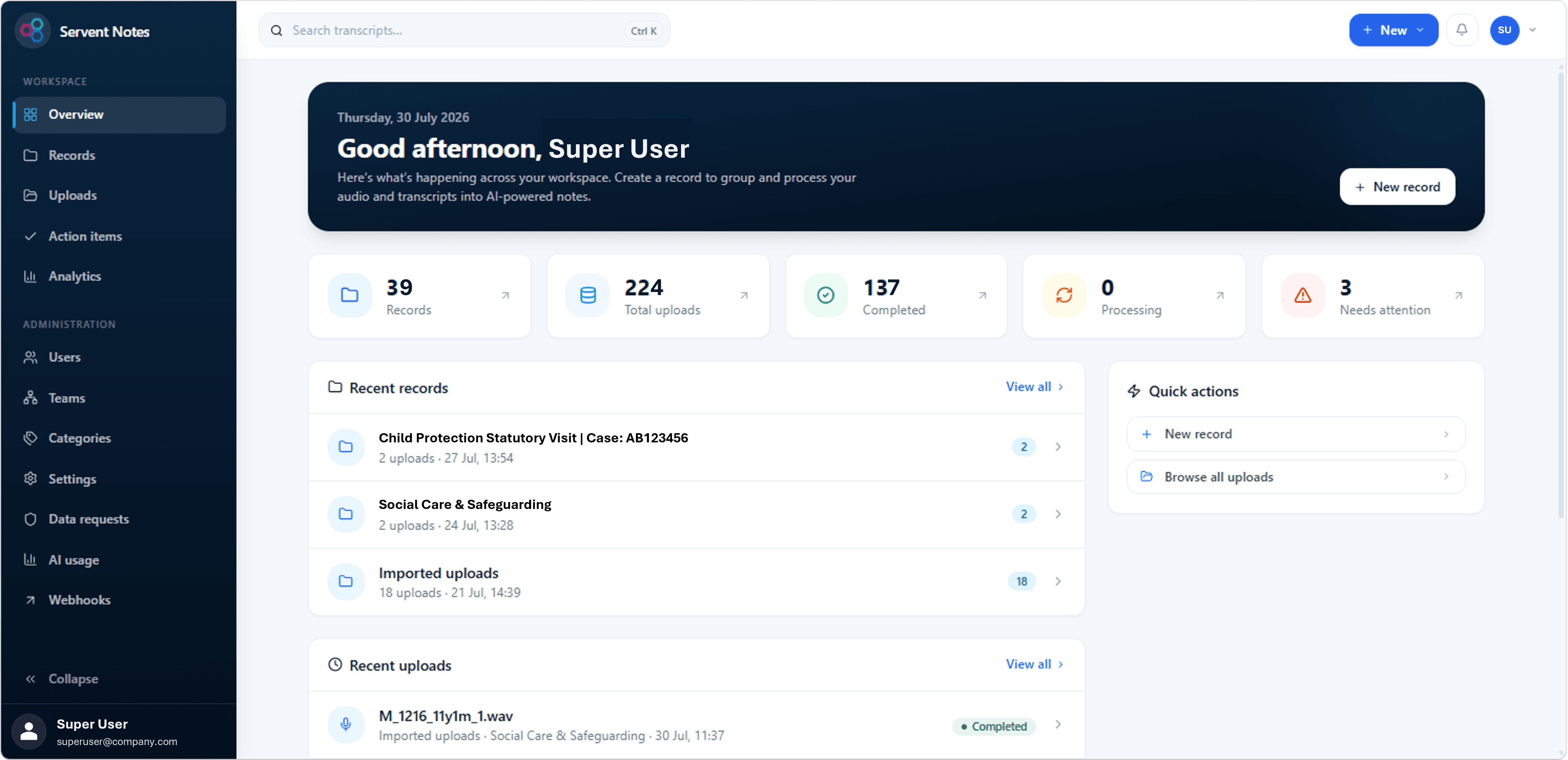
Servent Notes is designed for organisations that need to capture spoken interactions and turn them into structured draft records for professional review. It supports mobile and offline capture for field-based work and can produce structured information against the required record format.
Servent Notes is deployed into the customer’s own Microsoft Azure subscription and can use the organisation’s Microsoft Entra identity, Azure governance and monitoring controls. The customer therefore owns the Azure application environment in which Servent Notes is deployed. The exact location of AI processing depends on the Azure services and deployment configuration selected, so this should be documented as part of the architecture and information governance review.
Servent works with customers to assess the required workflow, Azure configuration, record structure and route into their existing systems. For organisations reviewing AI case-note technology, the sensible first step is to define the buying criteria before choosing the product.
Sources and further reading
Social Work England
The emerging use of Artificial Intelligence (AI) in social work
socialworkengland.org.uk
Local Government Association
Kingston Council: Using AI in Adult Social Care administration
local.gov.uk
Ada Lovelace Institute
Scribe and prejudice? Exploring the use of AI transcription tools in social care
adalovelaceinstitute.org
NHS England
Guidance on the use of AI-enabled ambient scribing products in health and care settings
england.nhs.uk
Information Commissioner’s Office (ICO)
Guidance on AI and data protection: accountability and governance implications
ico.org.uk
UK Government
Data and AI Ethics Framework
gov.uk
More from the blog: