
Gateway to AI · Article 02/08

AI-ready data: what models and agents need from your data estate

Gateway to AI · Article 02/08

AI-ready data: what models and agents need from your data estate

Your existing data estate may already support valuable AI applications. The challenge is knowing whether the information a particular use case needs is current, accessible, reliable and properly controlled.

A housing provider has a dashboard showing outstanding repairs, contractor performance and changes in demand. The reporting works. Managers can see where workloads are growing.

Now a service team wants an AI assistant to answer a tenant’s question:

When will my repair be completed?

The assistant needs the latest appointment, the repair history, notes from the contractor and perhaps a change recorded this morning. That information may be held across a repairs system, correspondence and external contractor updates. Some records may be restricted.

The dashboard can be correct without containing everything the assistant needs to answer that individual question. A production AI application has to retrieve the relevant information, apply the right permissions and handle gaps without inventing an answer.

The same data estate, different requirements

Reporting generally relies on defined measures, agreed business rules and established refresh schedules. An AI assistant answering an operational question may need record-level information that has changed since the last report refresh.

The difference becomes more important when an application can act. An assistant drafting a response for a colleague to review has different requirements from an agent authorised to update a repair record or send an appointment confirmation.

The data work should follow the task. Some use cases can rely on a well-governed existing analytical platform. Others require direct integration with operational systems, additional data-quality work or more frequent updates.

Figure A · The same repairs example, two different jobs

Existing reporting view

Summarised for monitoring and management decisions

Outstanding repair jobs

Contractor performance

Repairs by category

Reporting period · last refresh

AI assistant answering a repair enquiry

“When will my repair be completed?”

Information needed

Current repair record

Appointment information

Contractor updates and correspondence

Relevant policy

Controls applied

User permissions

Source references

A well-governed data platform may already provide much of this. What an AI application needs depends on the task, the users and how current the answer must be.

What the research says

Gartner surveyed data management leaders in 2024 on whether their organisations had the data management practices needed to support AI.

63%

Research · Gartner

Of the organisations surveyed, 63% either lacked confidence in their data management practices for AI or were unsure whether appropriate practices were in place.

Source: Gartner, Lack of AI-Ready Data Puts AI Projects at Risk, February 2025. Survey of 1,203 data management leaders conducted in July 2024.

Gartner also made a separate prediction: that through 2026, organisations would abandon 60% of AI projects unsupported by AI-ready data. That is a forecast for a specific group of projects, not a measured failure rate for AI projects generally.

The practical concern is familiar. A pilot can succeed with carefully selected examples. In production, records change, sources disagree, access rights differ and staff expect the answer to reflect the current position. The application needs a way to deal with those conditions.

Four checks before an AI application uses your data

For any particular use case, these four questions show whether the data is ready, and what work remains.
Four data-readiness checks

Right information

Can the application retrieve the relevant records?

Identify the records the use case needs and where they live. Check whether the application can reach them through a warehouse, lakehouse, API or operational system.

Quality and currency

Are the records accurate and current enough for the task?

Agree the authoritative source, how often it changes and what the application should do when records conflict or cannot be confirmed.

Permissions

Can users access only the information they’re authorised to see?

Retrieval can supply references for an answer, but the retrieval and application design still has to enforce permissions. Indexing documents does not automatically preserve every restriction.

Ownership and testing

Who owns the data, and how will its suitability be checked?

Name a business owner for each source. Agree acceptance tests that cover missing records, outdated information, restricted access and conflicting updates.

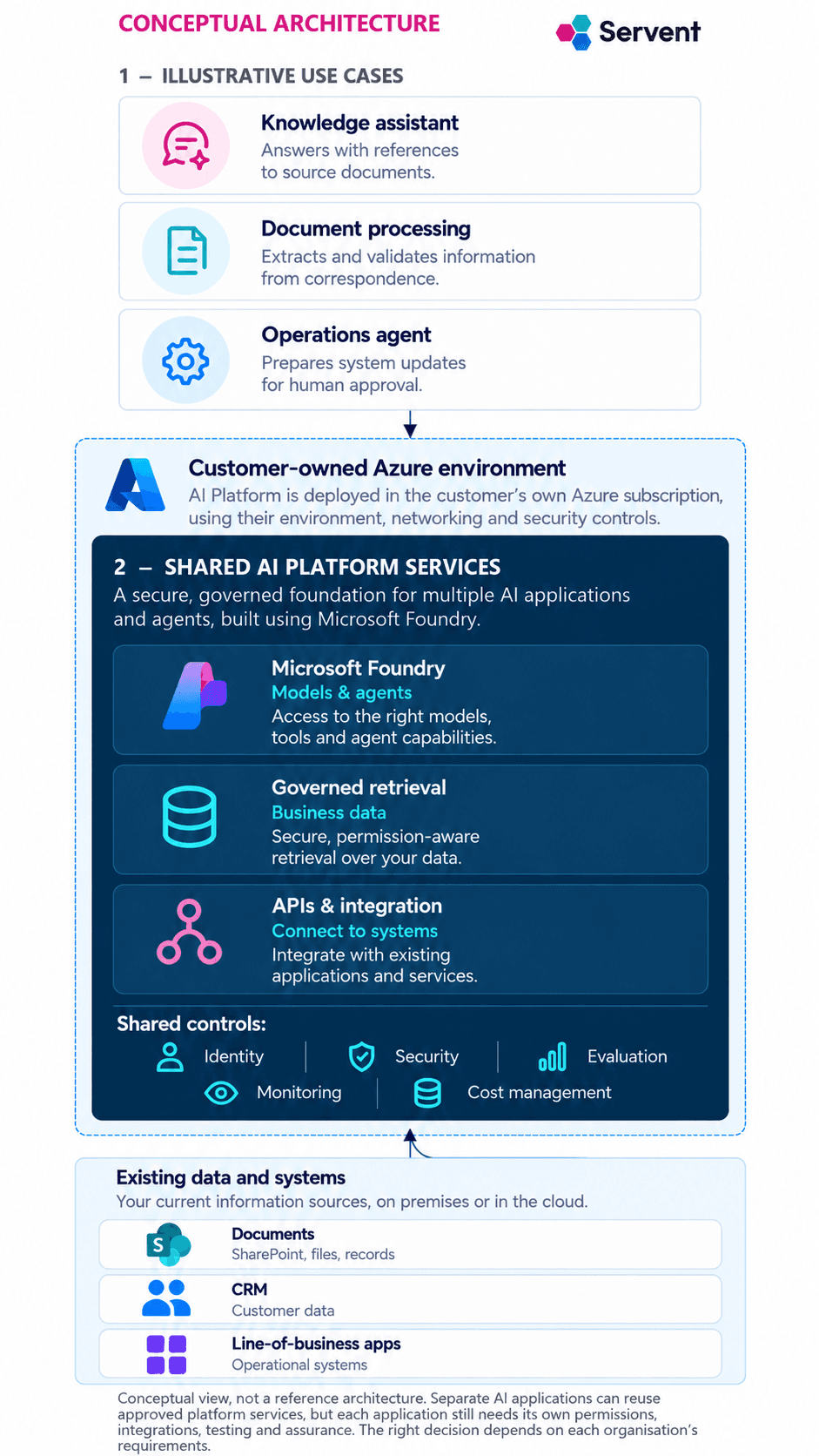
Conceptual architecture: three illustrative AI use cases reuse shared AI Platform services within the customer’s Azure environment, with governance, security and operations applying across all layers.

In the repairs example, the assistant should say so, or route the enquiry to a person, if the appointment cannot be confirmed. It should not guess.

Some of this work will already be done. If a well-governed platform supplies current, permissioned data for the use case, the assistant can use it. The point is to check, not to assume that either answer is true.

What we’ve found in customer data estates

Servent’s Data & Analytics work includes assessing fragmented estates and designing the changes needed to make their information easier to manage and use.

Two types of engagement are relevant here. One establishes the condition of an estate and what should change. The other delivers the Azure data platform. Both matter when an AI use case depends on information spread across existing systems.

Servent evidence

Two kinds of experience behind this article

Assessment and design

UK university data-maturity assessment

15

principal data sources examined

8

candidate use cases

Data ownership, definitions, quality controls and stewardship reviewed

Assessment and target-architecture work informing a prioritised improvement plan

Platform delivery

Enterprise Azure data-platform delivery

Multi-phase Azure data-platform engagement for a global aviation services organisation

Data integration and pipeline orchestration

SQL workloads and reporting architecture

Customers are anonymised. The university work was an assessment and design engagement; the platform work was delivery.

Start with the use case, then decide what to change

An organisation does not have to assess or rebuild every dataset before starting AI.

Take one worthwhile use case. List the information required, where it comes from, who owns it, how current it must be and who is allowed to access it. Test whether the existing data and application environment can supply that information reliably.

The findings may justify a focused integration, a change to access controls, better data-quality checks or a broader Data & Analytics programme. The amount of work should follow the evidence.

Where use-case priorities and wider readiness are still unclear, Servent’s AI Launchpad provides a structured, paid assessment. Where a specific data constraint is already known, a focused Data & Analytics discovery can define the necessary changes. Once the requirements are understood, AI Platform provides the governed environment for developing and operating the AI workload.

For your highest-priority AI use case, can you name the authoritative data sources, their owners, the required freshness and the permissions that must apply?

Gateway to AI is an eight-part Servent series examining what organisations need to develop, deploy and operate enterprise AI.

Research: Gartner, Lack of AI-Ready Data Puts AI Projects at Risk, 26 February 2025.

Previous in the series: Gateway to AI: what it takes to get AI into production

Can your AI use case reach the right data?

Talk to Servent about the source systems, access controls and data work needed to get your application into production.

Can your AI use case reach the right data?

Talk to Servent about the source systems, access controls and data work needed to get your application into production.

More from the blog:

Blog

Gateway to AI: what it takes to get AI into production

Blog

Gateway to AI: what it takes to get AI into production

Blog

Can Servent Notes support EHCP annual reviews?

Blog

Can Servent Notes support EHCP annual reviews?

Blog

Magic Notes vs Servent Notes: AI case recording for local government

Blog

Magic Notes vs Servent Notes: AI case recording for local government