


AI pilots can demonstrate impressive capabilities. Getting those same applications approved, connected to business systems and operating reliably is a different challenge. Here’s what organisations need to consider, and where a shared AI Platform makes sense.
An AI assistant has been demonstrated to the business. It can find information in internal documents, summarise correspondence and produce a reasonable answer in seconds.
The business sponsor wants to put it into use.
Then come the questions.
Can it access information the user shouldn’t see?
Where is that information processed?
Will it work with the systems staff already use?
What happens when an answer is wrong?
Who will support it, and what will it cost to run?
These are entirely reasonable questions. They also explain why a technically successful AI pilot can take considerably longer to reach production than anyone expected.
For organisations with several AI initiatives underway, the same questions arise repeatedly. Each application needs access to data, identity controls, security approval, integration and an operating model.
The work becomes increasingly difficult when individual teams have made different technology choices and implemented their own controls.
AI investment is growing. So is the need for control.
Boston Consulting Group’s September 2026 Applied AI Index found that almost half of the companies surveyed were generating meaningful value from AI.
Its findings also reveal the scale of the governance challenge.
42% of companies expect to give AI agents genuine decision-making authority by 2030. Only 5% have the full set of controls in place today.
Those figures matter because the consequences of AI behaviour change as applications take on more responsibility.
An assistant that produces a draft response for a member of staff to review has a different risk profile from an agent authorised to update customer records, initiate transactions or change information in a business system.
Both need appropriate controls. The second requires particular care over identity, permissions, testing, auditability and human oversight.
As organisations increase their AI investment, those decisions become part of the wider technology and operating model.
Research · Two separate measures
42%
of companies surveyed expect to give AI agents genuine decision-making authority by 2030.
Expectation for the future
5%
of companies surveyed have the full set of controls in place today.
Current state today
The figures measure different things and are not parts of one total. Source: Boston Consulting Group, Applied AI Index 2026, survey of 1,330 senior leaders, published 30 September 2026.
What building AI ourselves has taught us
At Servent, we’ve faced many of these design decisions while developing Servent Notes, our own Azure-based AI product.
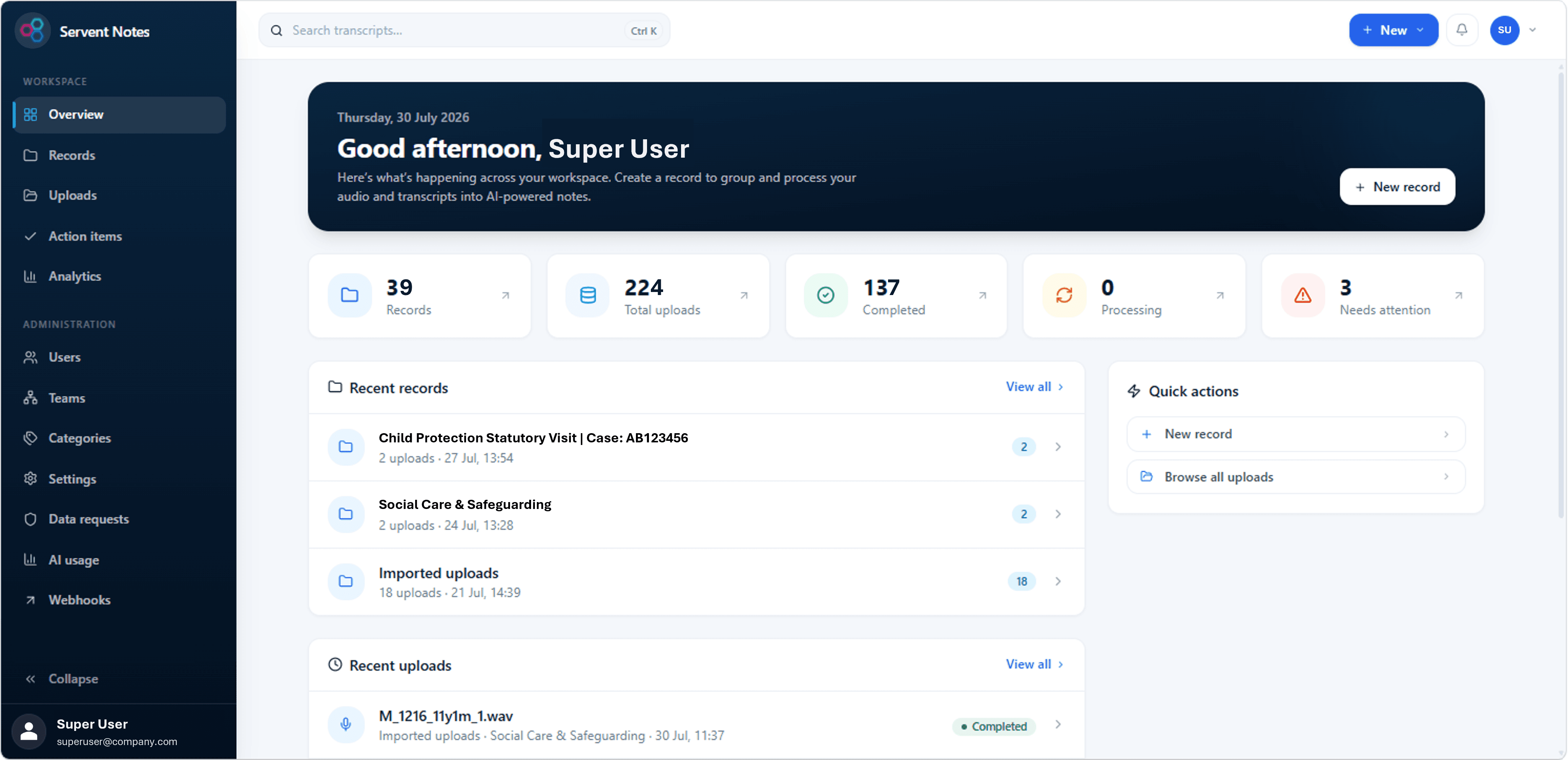
Servent Notes uses Azure AI Speech and Azure OpenAI, with application components running on Azure Container Apps.
It is designed for deployment into a customer’s own Azure subscription. This gives customers direct control over their Azure environment and the resources deployed within it, with model processing and data residency requirements addressed through its architecture.
That deployment approach is particularly relevant to organisations working with sensitive conversations and records.
The design needs to account for where information is processed and stored, who can access it, how permissions are applied and how people remain accountable for the information they use.
These decisions affect the architecture, development and operation of the product.
They have also informed our approach to building AI environments for customers.
One lesson is particularly relevant: an AI application depends on considerably more than the model producing its answers. The surrounding services and controls determine whether the application can be safely used and supported in practice.
When does a shared AI Platform make sense?
A single, narrowly defined AI use case may be able to run successfully using existing approved services and controls.
The case for a shared platform becomes stronger as organisations introduce more applications, connect additional business systems and need consistent ways to manage access, security, quality and costs.
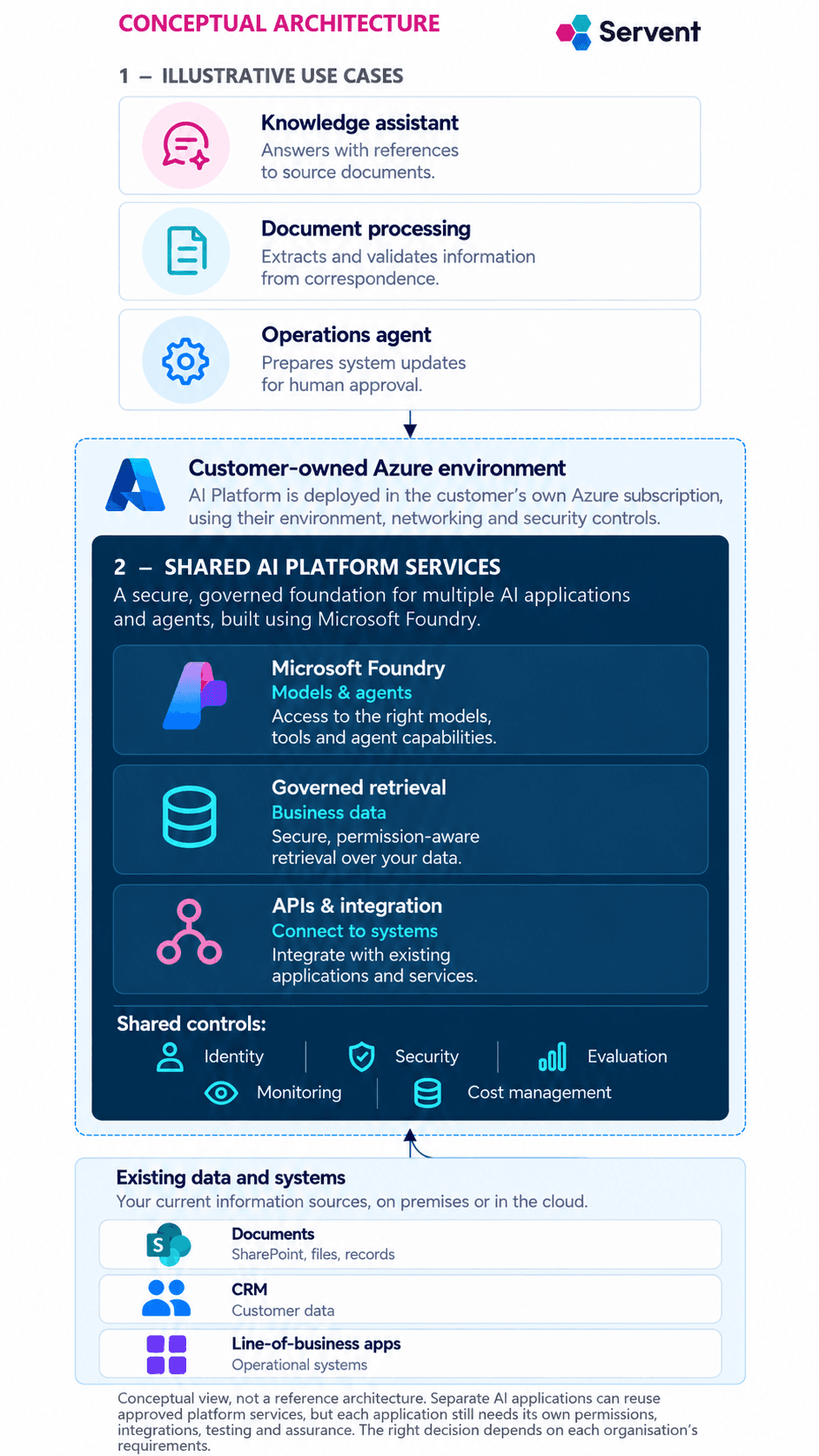
Consider three potential uses within the same organisation.
A service team wants an assistant that can retrieve internal procedures and answer questions with references to the original documents.
A finance team wants to extract information from supplier correspondence and validate it against existing records.
An operations team wants an agent that can retrieve information from a business application and prepare updates for human approval.
Each application has its own requirements. But much of the underlying work is similar.
The organisation needs to manage access to AI models, control which data can be retrieved, monitor usage, test changes, record activity and understand costs.
Building those arrangements independently for every application can create duplicated effort and inconsistent controls.
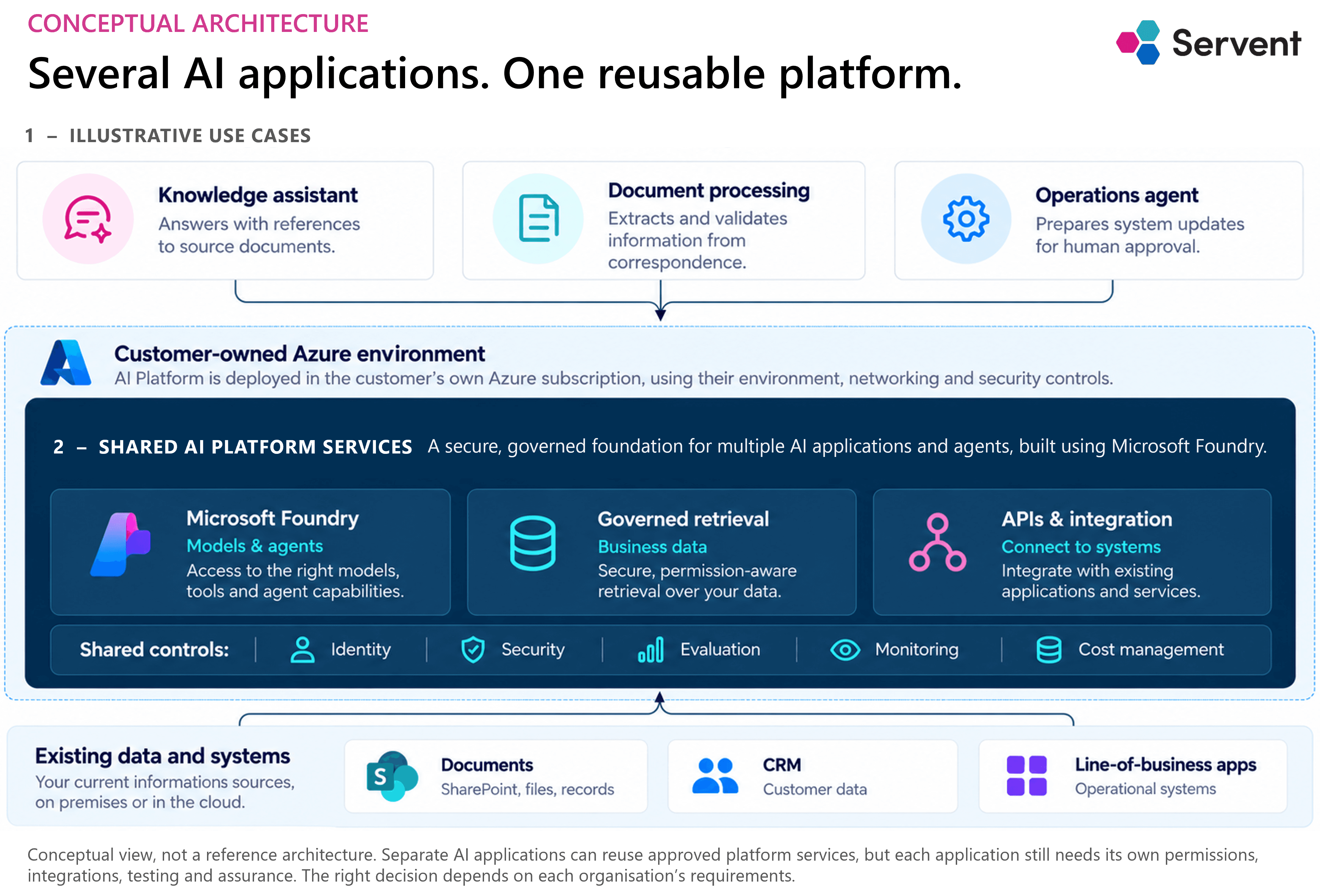
An enterprise AI platform provides common services that appropriately designed applications can reuse.
The benefit increases as more suitable use cases are added. New applications can inherit established technical arrangements, although each still needs its own permissions, integration testing and assurance.
The three questions every production AI application must answer
At Servent, we think about these requirements in three practical groups.
Is it safe?
The organisation needs to know which people and systems can access the application, what information it can retrieve and where processing takes place.
An AI assistant searching internal documents should respect the underlying access permissions. An agent calling a business application should only have the permissions required for its task.
Security teams also need evidence they can inspect: architecture, data flows, access controls, logging and arrangements for handling sensitive information.
Model choice matters here. Different AI models and deployment options have different data processing and residency characteristics.
These decisions should be agreed before production.
Is it useful?
The application needs to solve a defined business problem.
That requires reliable access to the right information, suitable connections to existing applications and a way to assess the quality of its outputs.
For a knowledge assistant, this could mean measuring whether responses are accurate, supported by appropriate sources and useful to the people doing the work.
For an agent updating a business system, the assessment will also cover whether it applies the correct rules and handles exceptions safely.
A production decision should include evidence that the application meets agreed acceptance criteria.
It also needs a business owner who can judge whether it improves the process.
Will it keep working?
Models change. Data changes. Business processes change.
Organisations need a way to test updates before release, monitor application behaviour, investigate failures and keep track of usage and costs.
There must also be someone responsible for the service.
Without clear ownership and operational arrangements, a useful AI application can become difficult to maintain as its dependencies and usage grow.
These requirements should be considered during design, with support responsibilities agreed before go-live.
The platform is the reusable part. The first use case proves it.
Servent’s AI Platform service addresses these requirements using Microsoft Foundry, formerly Azure AI Foundry, and supporting Azure services.
We build the environment within the customer’s own Azure subscription, bringing together the services needed for the agreed AI workloads.
Depending on the requirements, that includes access to AI models, retrieval over business information, integration with existing applications, security controls, testing, monitoring and operational processes.
The first use case is important because it tests the architecture against a genuine business requirement.
It establishes whether the application can access the necessary information, meet the quality requirements, pass security review and operate under agreed controls.
The same platform can then support further suitable use cases, reusing common components and avoiding repeated implementation work.
Some additional applications may be relatively straightforward. Others will require substantial development, particularly when new integrations, complex business rules or sensitive information are involved.
The advantage is having a common technical and operational approach that can be extended as requirements develop.
And that is why we describe the enterprise AI platform as the Gateway to AI.
It gives organisations a controlled way to introduce additional AI capabilities while retaining oversight of how those capabilities are developed and operated.
Deciding what to do first
Organisations arrive at this point with different starting positions.
Some already have an Azure environment, a well-defined AI use case and the people needed to own it. They may be ready to move into platform and solution design.
Others have several promising pilots but haven’t established which one should become a production service.
Some need to resolve gaps in their data estate, identity arrangements or application architecture before proceeding.
The first investment should reflect those circumstances.
Servent’s AI Launchpad is a structured assessment that examines the organisation’s proposed AI use cases alongside its applications, data, Azure environment and governance arrangements.
It provides a prioritised plan identifying what can proceed, what needs attention and where further design or delivery investment is justified.
That creates a clear basis for the next decision, whether that involves AI Platform, data improvements, application work or a more focused AI solution.
If you have an AI pilot that works in demonstration but hasn’t reached production, what is preventing it from going live?
Servent’s AI Launchpad can help establish the answer and define a practical next step.
Gateway to AI is an eight-part Servent series examining what organisations need to develop, deploy and operate enterprise AI.
Research source: Boston Consulting Group, Applied AI Index 2026, 30 September 2026.
More from the blog: