
Azure managed services with clear operational ownership

Azure managed services with clear operational ownership

Azure managed services with clear operational ownership

Keep critical Azure and Azure Virtual Desktop services reliable, controlled and improving without stretching your internal team.


Servent takes named responsibility for agreed Azure and AVD operations, with specialist capacity available for improvement and change.

Servent Notes secure record capture on a mobile device

Transfer responsibility for agreed Azure or Azure Virtual Desktop operations, or retain control and use Servent specialists for advice, improvement and change.


Each service can be purchased independently. Azure and AVD management can also be combined under one service model.

Transfer responsibility for agreed Azure or Azure Virtual Desktop operations, or retain control and use Servent specialists for advice, improvement and change.


Each service can be purchased independently. Azure and AVD management can also be combined under one service model.

Choose what you need Servent to own.

Choose what you need Servent to own.

Choose what you need Servent to own.

SERVENT AZURE MANAGED SERVICES

01 / MANAGED AZURE PLATFORM

Run our Azure platform

Give your Azure platform clear day-to-day ownership.


Servent monitors the environment, responds to incidents, manages planned maintenance and standard operational change, and keeps cost, security, resilience and capacity actions moving.

Give your Azure platform clear day-to-day ownership.


Servent monitors the environment, responds to incidents, manages planned maintenance and standard operational change, and keeps cost, security, resilience and capacity actions moving.

  • Azure monitoring and alert response.

  • Incident and problem management.

  • Patching, backup and recovery oversight.

  • Cost, security and capacity reviews.

  • Named service and Azure architecture ownership.

Best for organisations with business-critical Azure services, limited internal Azure operations capacity or fragmented supplier responsibilities.

02 / MANAGED AVD OPERATIONS

Run our Azure Virtual Desktop service

Give your Azure Virtual Desktop environment a specialist operating model.


Servent manages agreed AVD components, including host pools, images, session hosts, profiles, monitoring, updates, capacity and technical incidents.

  • Host-pool and session-host management.

  • Image, operating-system and FSLogix update cycles.

  • AVD monitoring and technical incident management.

  • Autoscale, capacity and cost reviews.

  • AVD architecture and change assurance.

Best for organisations running AVD at production scale where EUC or infrastructure teams need deeper Azure and AVD expertise.

03 / FLEXIBLE EXPERTISE

Give us access to Azure specialists

Keep operational ownership while gaining controlled access to Servent Azure specialists.


Purchase a bank of hours for architecture advice, optimisation recommendations, investigation, design review, improvement and agreed technical delivery.

  • Strategy and Azure architecture advice.

  • Design and configuration reviews.

  • Cost, security and resilience investigations.

  • New Service insight, automation and platform improvement.

  • Agreed engineering and delivery support.

Best for organisations that need regular access to Azure expertise without transferring ongoing operational responsibility.

Not sure which service fits? We will review your current responsibilities, immediate concerns and planned Azure changes, then recommend the most sensible route.

Not sure which service fits? We will review your current responsibilities, immediate concerns and planned Azure changes, then recommend the most sensible route.

WHY ORGANISATIONS NEED SUPPORT

Azure has become too important for fragmented ownership

Azure has become too important for fragmented ownership

Azure has become too important for fragmented ownership

As Azure estates grow, responsibility often spreads across infrastructure, security, finance, application, service-desk and supplier teams.

The technology may be in place, but the operating model can still leave important gaps in incident response, maintenance, recovery, cost control and planned change.

As Azure estates grow, responsibility often spreads across infrastructure, security, finance, application, service-desk and supplier teams.

The technology may be in place, but the operating model can still leave important gaps in incident response, maintenance, recovery, cost control and planned change.

Nobody clearly owns the response

Nobody clearly owns the response

Nobody clearly owns the response

Monitoring may identify a problem without answering who investigates it, who is authorised to make changes and who coordinates the response across teams and suppliers.

Incidents take longer to control because responsibility is agreed during, not before it.

Maintenance varies for the estate

Maintenance varies for the estate

Maintenance varies for the estate

Patching, backup, recovery checks, monitoring and platform configuration can be applied differently across subscriptions, workloads and service owners.

Important controls exist, but coverage and evidence are inconsistent.

Recommendations remain open

Recommendations remain open

Azure cost reviews, security tooling and platform assessments can produce useful findings without creating a clear owner, decision or delivery plan.

The organisation can see the issue but struggles to turn the recommendation into action.

Change awaits specialist capacity

Change awaits specialist capacity

Design decisions, investigations and small Azure improvements can wait behind internal priorities or require a new proposal, purchase order and procurement cycle.

Necessary work is delayed even when the requirement and funding are relatively small.

These problems do not all require the same response. Some organisations need Servent to take agreed operational responsibility. Others need specialist capacity while retaining control of day-to-day operations.

These problems do not all require the same response. Some organisations need Servent to take agreed operational responsibility. Others need specialist capacity while retaining control of day-to-day operations.

HOW THE SERVICES WORK TOGETHER

Two managed services. One route for change and improvement

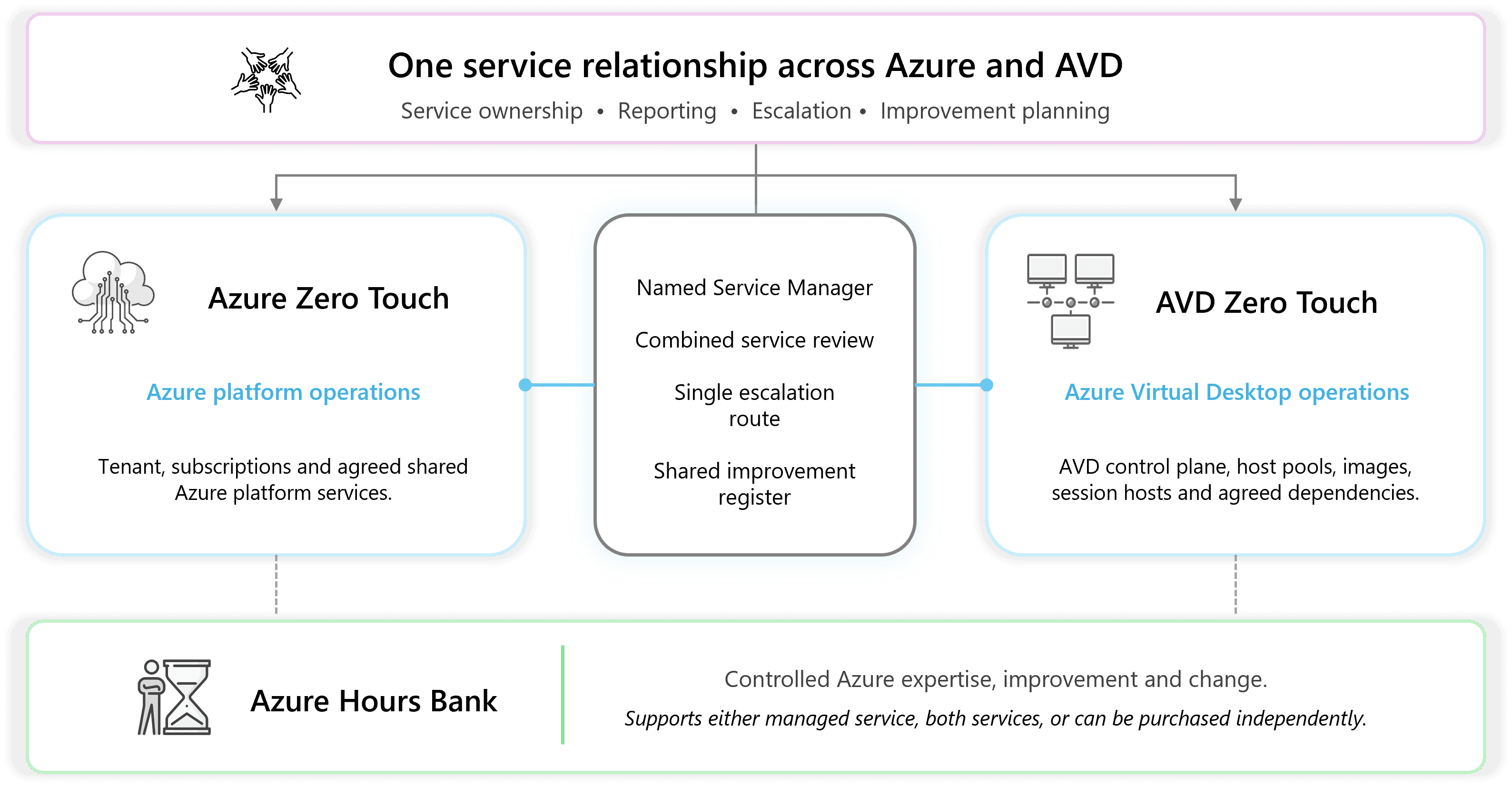
Azure Zero Touch manages agreed Azure platform services. AVD Zero Touch manages the Azure Virtual Desktop service and its named dependencies.


Purchase either service independently or combine them under one service-management model. Azure Hours Bank can then provide controlled capacity for larger changes and improvements outside the recurring service scope.

Azure Zero Touch manages agreed Azure platform services. AVD Zero Touch manages the Azure Virtual Desktop service and its named dependencies.


Purchase either service independently or combine them under one service-management model. Azure Hours Bank can then provide controlled capacity for larger changes and improvements outside the recurring service scope.

One named service owner

One named service owner

A single point of ownership across the agreed Azure and AVD service boundary.

One reporting rhythm

One reporting rhythm

Azure and AVD performance, risks, actions and priorities reviewed together

Clear technical hand-offs

Clear technical hand-offs

Responsibilities across Azure, AVD and shared dependencies agreed from the start.

Controlled change capacity

Controlled change capacity

Larger improvements routed through Hours Bank or a separately scoped project.

Compare the operating models

The most important difference is who retains day-to-day operational responsibility.

The most important difference is who retains day-to-day operational responsibility.

Comparison of Azure Zero Touch, AVD Zero Touch and Azure Hours Bank
Azure Zero TouchManaged Azure platform operationsAVD Zero TouchManaged Azure Virtual Desktop operationsAzure Hours BankFlexible expertise and controlled change
Who owns day-to-day operations?Servent for the agreed Azure platform scopeServent for the agreed AVD scopeThe client
Primary purposeOperate and improve Azure platform servicesOperate and improve Azure Virtual DesktopProvide advice, investigation and controlled change
Monitoring and incidentsIncluded for agreed Azure servicesIncluded for agreed AVD servicesTime-boxed investigation only
MaintenanceAgreed platform and operating-system scopeImages, session hosts and agreed AVD componentsAdvisory or approved delivery support
Routine changeDefined service allowanceDefined service allowanceDrawn from purchased hours
Larger improvement workAzure Hours Bank or separate projectAzure Hours Bank or separate projectCore purpose of the service
ReportingMonthly service and quarterly value reviewsMonthly service and quarterly value reviewsUsage, outcomes and remaining capacity

Azure Zero Touch

Managed Azure platform operations

Who owns day-to-day operations?
Servent for the agreed Azure platform scope
Primary purpose
Operate and improve Azure platform services
Monitoring and incidents
Included for agreed Azure services
Maintenance
Agreed platform and operating-system scope
Routine change
Defined service allowance
Larger improvement work
Azure Hours Bank or separate project
Reporting
Monthly service and quarterly value reviews

AVD Zero Touch

Managed Azure Virtual Desktop operations

Who owns day-to-day operations?
Servent for the agreed AVD scope
Primary purpose
Operate and improve Azure Virtual Desktop
Monitoring and incidents
Included for agreed AVD services
Maintenance
Images, session hosts and agreed AVD components
Routine change
Defined service allowance
Larger improvement work
Azure Hours Bank or separate project
Reporting
Monthly service and quarterly value reviews

Azure Hours Bank

Flexible expertise and controlled change

Who owns day-to-day operations?
The client
Primary purpose
Provide advice, investigation and controlled change
Monitoring and incidents
Time-boxed investigation only
Maintenance
Advisory or approved delivery support
Routine change
Drawn from purchased hours
Larger improvement work
Core purpose of the service
Reporting
Usage, outcomes and remaining capacity
Comparison of Azure Zero Touch, AVD Zero Touch and Azure Hours Bank
Azure Zero TouchManaged Azure platform operationsAVD Zero TouchManaged Azure Virtual Desktop operationsAzure Hours BankFlexible expertise and controlled change
Who owns day-to-day operations?Servent for the agreed Azure platform scopeServent for the agreed AVD scopeThe client
Primary purposeOperate and improve Azure platform servicesOperate and improve Azure Virtual DesktopProvide advice, investigation and controlled change
Monitoring and incidentsIncluded for agreed Azure servicesIncluded for agreed AVD servicesTime-boxed investigation only
MaintenanceAgreed platform and operating-system scopeImages, session hosts and agreed AVD componentsAdvisory or approved delivery support
Routine changeDefined service allowanceDefined service allowanceDrawn from purchased hours
Larger improvement workAzure Hours Bank or separate projectAzure Hours Bank or separate projectCore purpose of the service
ReportingMonthly service and quarterly value reviewsMonthly service and quarterly value reviewsUsage, outcomes and remaining capacity

Azure Zero Touch

Managed Azure platform operations

Who owns day-to-day operations?
Servent for the agreed Azure platform scope
Primary purpose
Operate and improve Azure platform services
Monitoring and incidents
Included for agreed Azure services
Maintenance
Agreed platform and operating-system scope
Routine change
Defined service allowance
Larger improvement work
Azure Hours Bank or separate project
Reporting
Monthly service and quarterly value reviews

AVD Zero Touch

Managed Azure Virtual Desktop operations

Who owns day-to-day operations?
Servent for the agreed AVD scope
Primary purpose
Operate and improve Azure Virtual Desktop
Monitoring and incidents
Included for agreed AVD services
Maintenance
Images, session hosts and agreed AVD components
Routine change
Defined service allowance
Larger improvement work
Azure Hours Bank or separate project
Reporting
Monthly service and quarterly value reviews

Azure Hours Bank

Flexible expertise and controlled change

Who owns day-to-day operations?
The client
Primary purpose
Provide advice, investigation and controlled change
Monitoring and incidents
Time-boxed investigation only
Maintenance
Advisory or approved delivery support
Routine change
Drawn from purchased hours
Larger improvement work
Core purpose of the service
Reporting
Usage, outcomes and remaining capacity
Comparison of Azure Zero Touch, AVD Zero Touch and Azure Hours Bank
Azure Zero TouchManaged Azure platform operationsAVD Zero TouchManaged Azure Virtual Desktop operationsAzure Hours BankFlexible expertise and controlled change
Who owns day-to-day operations?Servent for the agreed Azure platform scopeServent for the agreed AVD scopeThe client
Primary purposeOperate and improve Azure platform servicesOperate and improve Azure Virtual DesktopProvide advice, investigation and controlled change
Monitoring and incidentsIncluded for agreed Azure servicesIncluded for agreed AVD servicesTime-boxed investigation only
MaintenanceAgreed platform and operating-system scopeImages, session hosts and agreed AVD componentsAdvisory or approved delivery support
Routine changeDefined service allowanceDefined service allowanceDrawn from purchased hours
Larger improvement workAzure Hours Bank or separate projectAzure Hours Bank or separate projectCore purpose of the service
ReportingMonthly service and quarterly value reviewsMonthly service and quarterly value reviewsUsage, outcomes and remaining capacity

Azure Zero Touch

Managed Azure platform operations

Who owns day-to-day operations?
Servent for the agreed Azure platform scope
Primary purpose
Operate and improve Azure platform services
Monitoring and incidents
Included for agreed Azure services
Maintenance
Agreed platform and operating-system scope
Routine change
Defined service allowance
Larger improvement work
Azure Hours Bank or separate project
Reporting
Monthly service and quarterly value reviews

AVD Zero Touch

Managed Azure Virtual Desktop operations

Who owns day-to-day operations?
Servent for the agreed AVD scope
Primary purpose
Operate and improve Azure Virtual Desktop
Monitoring and incidents
Included for agreed AVD services
Maintenance
Images, session hosts and agreed AVD components
Routine change
Defined service allowance
Larger improvement work
Azure Hours Bank or separate project
Reporting
Monthly service and quarterly value reviews

Azure Hours Bank

Flexible expertise and controlled change

Who owns day-to-day operations?
The client
Primary purpose
Provide advice, investigation and controlled change
Monitoring and incidents
Time-boxed investigation only
Maintenance
Advisory or approved delivery support
Routine change
Drawn from purchased hours
Larger improvement work
Core purpose of the service
Reporting
Usage, outcomes and remaining capacity

Final scope, service boundaries and responsibilities are confirmed during discovery and, where required, a supportability assessment.

Final scope, service boundaries and responsibilities are confirmed during discovery and, where required, a supportability assessment.

You do not need to transfer responsibility for everything. Servent will help define which services it should operate, which responsibilities should remain with your team and how larger change should be controlled.

You do not need to transfer responsibility for everything. Servent will help define which services it should operate, which responsibilities should remain with your team and how larger change should be controlled.

Managed-service pathway

Managed-service pathway

Managed-service pathway

This creates a clear starting point for both teams and prevents unresolved risk from being hidden inside the recurring service.

This creates a clear starting point for both teams and prevents unresolved risk from being hidden inside the recurring service.

This creates a clear starting point for both teams and prevents unresolved risk from being hidden inside the recurring service.

Before Servent accepts operational responsibility, we confirm what is in scope, whether the environment is supportable and what must change before service begins.

Before Servent accepts operational responsibility, we confirm what is in scope, whether the environment is supportable and what must change before service begins.

Before Servent accepts operational responsibility, we confirm what is in scope, whether the environment is supportable and what must change before service begins.

A controlled route into managed service

A controlled route into managed service

A controlled route into managed service

STARTING THE SERVICE

  1. Assess

    Assess the environment

    Review the in-scope estate, operating model, monitoring, maintenance, access and service dependencies.

    Outputs
    • Resource baseline
    • Responsibility matrix
    • Initial risk register
  2. Prepare

    Address material gaps

    Agree and complete the work required to make the environment practical and supportable.

    Outputs
    • Remediation plan
    • Completed actions
    • Updated evidence
  3. Transition

    Establish the service

    Configure access, monitoring, service processes, runbooks and escalation routes.

    Outputs
    • Agreed access
    • Operational runbooks
    • Service acceptance
  4. Operate and improve

    Run the agreed service

    Manage the environment, report performance and maintain a prioritised improvement plan.

    Outputs
    • Monthly review
    • Improvement register
    • Quarterly value review

The result is a service with a defined boundary, known responsibilities and a documented improvement plan from the start.

SERVICE VALUE

SERVICE VALUE

A managed service should show more than tickets closed and activity completed.

A managed service should show more than tickets closed and activity completed.

Evidence that the service is working

Evidence that the service is working

Evidence that the service is working

Servent reports what changed, what risk was reduced, what cost action was taken and what needs to happen next.

Servent reports what changed, what risk was reduced, what cost action was taken and what needs to happen next.

Operational control

Operational control

See service health, material incidents, restoration performance, maintenance activity and recurring problems.

Risk and resilience

Track patching, backup, recovery, security actions and dependencies that require attention.

Cost and capacity

Review approved cost actions, consumption trends, resource growth and future capacity needs.

Continuous improvement

See completed actions, outstanding decisions and priorities planned for the next period.

A regular service rhythm

Operational pulse

Monthly service review

What happened, what changed and what needs attention now.

Service health Material incidents, response and restoration performance.
Operations completed Monitoring, maintenance and agreed changes delivered.
Risks and dependencies Open actions, blockers and customer decisions required.
Next planned activity Immediate priorities and actions for the next period.
Value direction

Quarterly value review

What the evidence means and what should happen next.

01
Review the evidence Service trends, recurring problems and improvement progress.
02
Assess value and risk Cost actions, resilience priorities and changing capacity needs.
03
Set the next priorities Decisions and planned activity for the next quarter.
From reporting to action Every review ends with agreed actions, named owners and clear dates.

Reporting Structure

Example reporting structure

Azure managed service report

A clear view of service performance, risks, actions and priorities.

Illustrative structure
Service health

Current service position

Service position reviewed
  • Overall service health
  • Material service events
  • Customer dependencies
Incidents

Material events and response

Response, restoration, recurring issues and problem actions.

Changes

Work completed

Standard operational changes Maintenance activity Planned next actions
Cost actions

Decisions and progress

Identified
Approved
Completed

Visual treatment only — no customer figures shown.

Risk actions

Items requiring attention

Maintenance Recovery Security Dependencies

Open actions are assigned an owner, target date and status.

Improvement

Progress and next priorities

Completed
In progress
Next

Actions completed, priorities underway and decisions required next.

Service evidence is used to agree priorities, manage risk and keep the service aligned to the clients changing Azure environment.

WHY SERVENT

Azure specialists with delivery depth and operational accountability

Azure specialists with delivery depth and operational accountability

Azure specialists with delivery depth and operational accountability

Servent’s Azure experience spans platform engineering, security, migration, Azure Virtual Desktop, SAP, application platforms, data and AI.

That breadth matters in managed service because incidents and changes rarely remain within a single technical boundary.

Experience across the Azure estate

Servent designs, builds and supports Azure landing zones, infrastructure, virtual desktops, application platforms and specialist workloads.

Practical experience from initial platform design through to live operation.

Problems do not stay in one technology

Azure incidents can cross identity, networking, compute, storage, profiles, applications and third-party services.

Servent brings the architecture and engineering depth needed to investigate the complete service.

Named ownership, not anonymous support

Customers receive agreed service responsibilities, named technical oversight and a regular rhythm for reporting, risk and improvement.

Clear ownership before incidents happen, not while they are unfolding.

The value of a specialist managed service is not only how it responds to incidents. It is the depth available to understand the environment, make informed decisions and keep the platform improving.

IS THIS RIGHT FOR YOU?

IS THIS RIGHT FOR YOU?

When Azure Managed Services is a good fit

When Azure Managed Services is a good fit

Servent is a strong fit where Azure has become operationally important but responsibility, capacity or specialist expertise has not kept pace.

Azure supports important production services

An Azure incident now has a direct operational or business impact.

Internal Azure capacity
is stretched

Prepare Azure, the workflow and the agreed draft output.

Ownership is spread across teams and suppliers

Infrastructure, security, applications, service desk and third parties all own part of the answer.

A project is moving
into production

A migration, landing zone or AVD deployment needs a clear operating model after go-live.

Cost, security or resilience actions remain open

The findings exist, but ownership and delivery capacity are preventing them from closing.

AVD has outgrown the current operating model

The environment now needs deeper Azure and AVD expertise than the existing EUC model provides.

Servent can operate alongside your internal IT team, service desk and other suppliers. The service boundary defines who retains each responsibility and where Servent takes ownership.

START WITH A REVIEW

START WITH A REVIEW

Review how your Azure environment is being run today

Book a 30-minute discussion with Servent.

01
Ownership

Who owns incidents, decisions and escalation?

02
Operations

How are monitoring, maintenance and support handled?

03
Risk & resilience

Where are the obvious support, recovery or security gaps?

04
Cost & capacity

Are spend, growth and capacity actively managed?

05
Change & improvement

How does necessary Azure change get delivered?

Your Azure Operating
model
Responsibility, control and capacity
Recommended next step
Managed operations

Azure Zero Touch

Managed Azure platform operations

Managed operations

AVD Zero Touch

Managed Azure Virtual Desktop operations

Expert capacity

Azure Hours Bank

Flexible Azure expertise and change

Deeper assessment

Supportability assessment

Before operational responsibility transfers

Frequently asked questions

Frequently asked questions

Frequently asked questions

What does Servent Azure Managed Services include?

Which service is right for us?

Can the services be bought separately?

What happens before Servent takes operational responsibility?

Is the managed service available 24/7?

What remains our responsibility?

Can Servent work alongside our existing service desk or MSP?

How is the service priced?

Still not sure which model fits? - We can review your current operating model and recommend the most sensible route.